Treatment Guide
Ultherapy Equipment Specifications — Handpieces, Transducers, and Depth Settings
The actual technical specs of the Ultherapy and Ultherapy PRIME platforms used in Korean dermatology clinics, translated from spec-sheet language into what each number means in the consult room and on the treatment table.
Most marketing pages about Ultherapy describe the procedure in feel-good language — lift, tighten, collagen, no downtime — without ever naming the actual hardware. That is fine for a generic landing page, but it is not fine for an international patient about to fly halfway around the world and pay USD 1,200-1,800 for a procedure whose result depends almost entirely on which cartridge the physician selects and at what depth she fires it. This page is the spec sheet, demystified. The Ultherapy platform, manufactured by Merz Aesthetics and cleared by both the US FDA (2009 initial clearance, updated for PRIME generation) and Korea's MFDS, uses a single handpiece that accepts swappable transducer cartridges. Each cartridge is engraved with a code like DS4-4.5 or DS7-3.0, and that code is the entire procedure: the first number is the MHz frequency of the ultrasound, and the second number is the depth in millimeters where the focused energy creates its thermal coagulation point. The four standard cartridges (DS4-3.0, DS4-4.5, DS7-3.0, DS10-1.5) cover the full face-and-neck protocol, from the deep SMAS layer at 4.5mm down to the superficial dermis at 1.5mm. Ultherapy PRIME, the upgraded platform generation rolled out from 2022-2024, runs the same cartridge family but adds finer real-time imaging, more uniform energy delivery, and shorter pulse durations. This page walks through what every line on the spec sheet actually means, why the cartridge selection sequence matters as much as the total shot count, and how to read the equipment line on a Korean clinic's consult form. Y'all, this is the page you read when you want to understand what is actually happening to your face, not just what the brochure says.
The Ultherapy and Ultherapy PRIME platform — what is on the cart
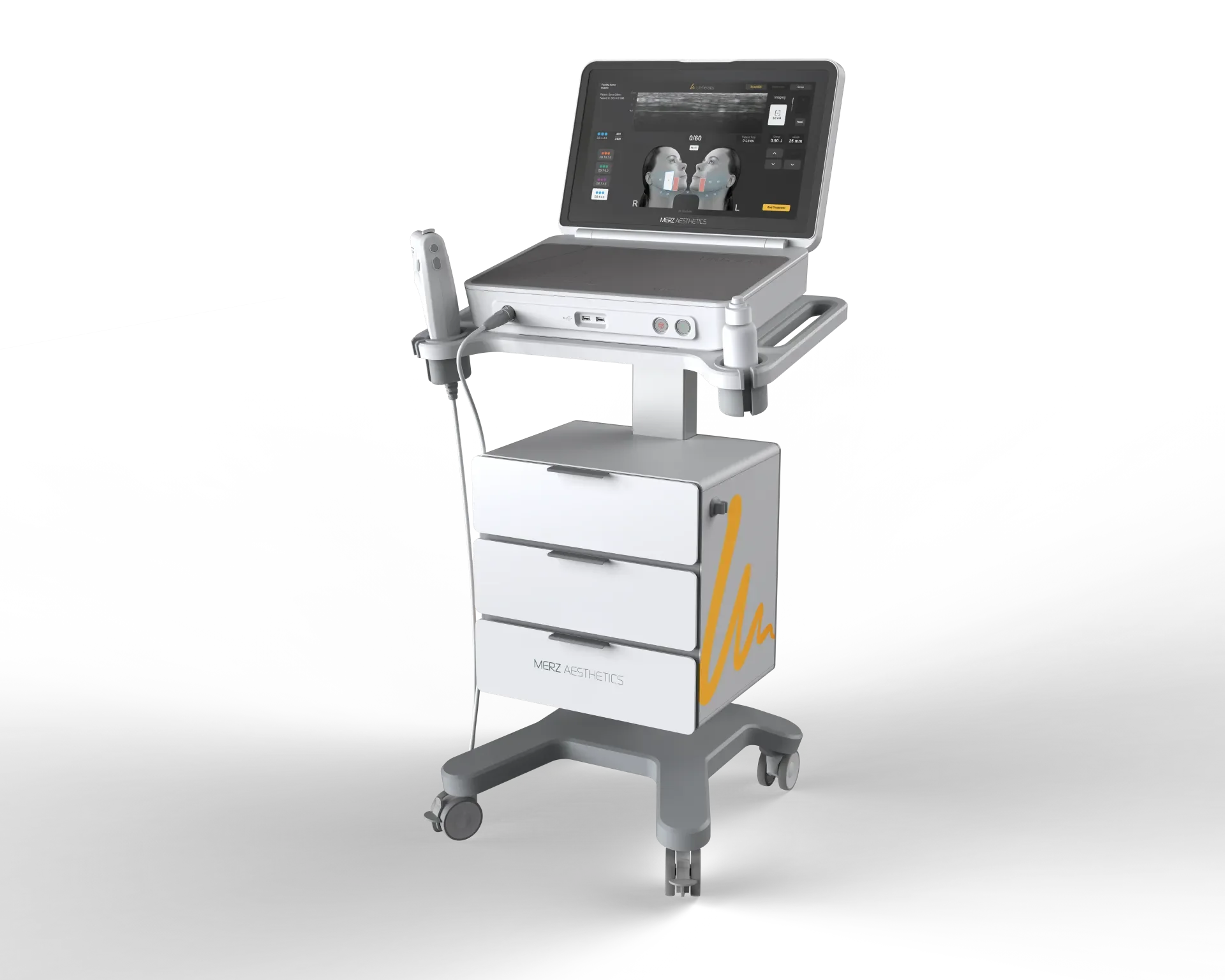
The Ultherapy platform is a wheeled console (think hospital ultrasound cart, roughly the size of a small filing cabinet) with a touchscreen interface, a single handpiece on a coiled cable, and a tray of swappable transducer cartridges. The console controls the energy delivery and the imaging display; the handpiece delivers the micro-focused ultrasound to the skin; the cartridges determine the depth and frequency of each shot. Ultherapy PRIME, the current Merz Aesthetics platform generation, replaced the original Ulthera DeepSEE console starting in 2022. The differences from the patient's perspective: PRIME has a higher-resolution real-time ultrasound imaging display, which lets the physician see tissue density variation in addition to a flat depth marker; PRIME has redesigned transducer electronics that deliver more uniform energy per shot across the treatment field, reducing bright-spot and cold-spot variability; and PRIME has shorter individual pulse durations, which translates to a measurably more tolerable in-room experience (returning patients commonly report PRIME sessions as 1-2 points lower on a 10-point pain scale than the equivalent legacy Ulthera session). The procedure protocol, the FDA and MFDS regulatory clearance, the underlying micro-focused-ultrasound mechanism, and the cartridge family are unchanged between Ulthera and PRIME. The price differential on Korean published price lists runs 15-25 percent, with PRIME at the upper end.
- Console — touchscreen interface, energy controls, real-time ultrasound imaging display
- Handpiece — single unit on coiled cable, accepts swappable cartridges
- Cartridges — four standard codes (DS4-3.0, DS4-4.5, DS7-3.0, DS10-1.5)
- PRIME upgrade — finer imaging, more uniform energy, shorter pulse duration
- Unchanged — FDA and MFDS clearance, mechanism, cartridge family, protocol
Reading the cartridge code — frequency, depth, and what each does
Every Ultherapy cartridge is engraved with a two-part code: the first number is the ultrasound frequency in megahertz, the second number is the depth in millimeters where the focused energy creates the thermal coagulation point. DS4-4.5 reads as four megahertz, four-and-a-half millimeters deep. DS7-3.0 reads as seven megahertz, three millimeters deep. The frequency-depth relationship is inverse and consistent across the cartridge family: lower frequency cartridges penetrate deeper (4 MHz reaches the SMAS at 4.5mm), higher frequency cartridges concentrate energy more superficially (10 MHz produces tightening at 1.5mm in the upper dermis). Each focused shot creates a discrete thermal coagulation point of roughly one cubic millimeter, which triggers the local collagen and elastin remodeling response that produces the lift and tightening result over the following 8-12 weeks. The depth is not approximate or adjustable in software; it is fixed by the physical focal geometry of the cartridge's transducer crystal. A DS4-4.5 cartridge cannot fire at 3mm; you swap to a DS4-3.0 (or DS7-3.0) cartridge for that depth. This is why a complete Ultherapy session sequences through multiple cartridges — the protocol covers multiple anatomical depths, and each depth requires its own cartridge swap. The total shot count (300, 450, 600, 800-shot tiers on most Korean price lists) is distributed across cartridges according to the treatment plan.
DS4-4.5 — the deep SMAS workhorse
DS4-4.5 fires at 4 MHz and targets 4.5 millimeters of depth, which is the SMAS (superficial musculoaponeurotic system) layer for most patients in the lower face and neck. The SMAS is the connective tissue layer that surgical face-lifts physically tighten; Ultherapy and PRIME target this same layer with focused ultrasound thermal coagulation, triggering remodeling without an incision. DS4-4.5 is the workhorse cartridge for jawline contouring, jowl tightening, and submental (under-chin) lifting. On a typical 600-shot full-face Ultherapy PRIME session, roughly 40-50 percent of the shot count is delivered via the DS4-4.5 cartridge concentrated along the lower face and neck. The depth selection is partly skin-thickness dependent: very thin or very thick skin shifts the optimal depth slightly, which is one of the reasons the PRIME platform's higher-resolution real-time imaging matters — it lets the physician confirm in the moment whether the 4.5mm focal point is landing on the SMAS layer rather than above or below it. The patient sensation from DS4-4.5 shots is the deepest and most distinct of the four cartridges, often described as a brief warm pressure or a heat-with-a-hum feeling. It is the spec line you want to see on the consult form for any patient seeking lower-face lift.
DS4-3.0 and DS7-3.0 — the mid-dermis cartridges
DS4-3.0 (4 MHz, 3 millimeters) and DS7-3.0 (7 MHz, 3 millimeters) both target the 3mm depth in the mid-dermis, but with different energy profiles. DS4-3.0 uses the lower 4 MHz frequency and produces a wider thermal coagulation footprint at the target depth, useful for broader tightening across the cheek and lateral face. DS7-3.0 uses the higher 7 MHz frequency and produces a more focused, tighter coagulation point, useful for precision work along the periocular region, the upper cheek, and areas where shot placement needs to avoid superficial structures. On a typical full-face protocol, the two 3mm cartridges together account for roughly 30-40 percent of shot count, distributed across the cheeks, the periocular area, the forehead, and the perioral region. The cartridge selection between DS4-3.0 and DS7-3.0 at the 3mm depth is one of the more physician-judgment-driven choices in the protocol — there is no single right answer, and the PRIME platform's real-time imaging helps the treating physician make the selection based on the actual tissue density she sees as she places each shot. The patient sensation from 3mm shots is intermediate between the deep DS4-4.5 shots and the superficial DS10-1.5 shots, generally described as a brief sharp warmth that fades within seconds.
DS10-1.5 — the superficial cartridge for fine lines and texture
DS10-1.5 fires at 10 MHz and targets 1.5 millimeters of depth, which is the upper dermis just below the dermal-epidermal junction. The thermal coagulation at this depth triggers a different biological response than the deeper cartridges — less SMAS lift, more upper-dermal collagen remodeling that improves fine line texture, skin smoothness, and overall surface quality. DS10-1.5 is the cartridge selected for areas where the visible target is texture rather than lift: the periocular crow's-feet zone, the perioral lines, the forehead horizontal lines, and sometimes the upper neck for skin-quality improvement. On a typical 600-shot full-face PRIME protocol, the DS10-1.5 cartridge accounts for roughly 15-25 percent of shot count, concentrated in the periocular and perioral zones. The patient sensation from DS10-1.5 shots is the most superficial of the four cartridges and is sometimes described as a pin-prick warmth or a brief stinging sensation; the in-room experience is generally more tolerable than the deeper DS4-4.5 shots. Not every full-face protocol uses DS10-1.5 — some physicians omit it for patients whose primary goal is lower-face lift rather than upper-face texture, redirecting the 1.5mm shot count to additional DS4-4.5 shots. This is one of the cartridge-selection conversations to have during the consult.
Cartridge selection sequence — at a glance
Cartridge family overview with frequency, depth, anatomical target, and typical shot-count share on a 600-shot full-face Ultherapy PRIME protocol. Categorical guidance, not a personalized treatment plan.
| Cartridge | Frequency | Depth | Anatomical target | Typical shot share |
|---|---|---|---|---|
| DS4-4.5 | 4 MHz | 4.5 mm | SMAS layer — lower face and neck | 40-50% |
| DS4-3.0 | 4 MHz | 3.0 mm | Mid-dermis — broader tightening | 15-25% |
| DS7-3.0 | 7 MHz | 3.0 mm | Mid-dermis — precision placement | 15-25% |
| DS10-1.5 | 10 MHz | 1.5 mm | Upper dermis — texture and fine lines | 15-25% |
What to ask in the consult about equipment
The single most useful equipment question to ask a Korean dermatology clinic during the consult is which cartridges the physician plans to use, and approximately how the shot count will be distributed across them. A reputable clinic will answer specifically — something like 'we plan 280 shots DS4-4.5 along the jawline and neck, 150 shots split between DS4-3.0 and DS7-3.0 on the cheeks, 120 shots DS10-1.5 on the periocular and perioral zones, total 550 shots in the 600-tier' — rather than vaguely. The second question worth asking is whether the platform is the current Ultherapy PRIME generation or the legacy Ulthera unit; the cartridge family is identical between the two, but the imaging precision and the in-room experience differ meaningfully, as does the typical published price. The third question, and this is where many international patients miss a real piece of information, is whether the physician has a preferred deviation from the standard 40-50-15-15 protocol for your specific face — some patients benefit from a higher DS4-4.5 share for stronger lower-face lift, others benefit from more DS10-1.5 for texture work. The PRIME platform's real-time imaging is precisely what lets the physician make this customization with confidence. A clinic that cannot answer cartridge-selection questions specifically is signaling that the protocol is being run by the device default rather than by physician judgment, which is a different (and lower-value) product even at the same shot-count tier.
“Ultherapy is not a single procedure; it is a sequence of cartridge selections, each landing thermal coagulation at a specific depth. Understanding the four-cartridge family (DS4-3.0, DS4-4.5, DS7-3.0, DS10-1.5) turns the consult from a brochure conversation into a treatment plan conversation, and that shift is where the result actually lives.”
Sarah Mitchell, Korea Ultherapy equipment-specifications field notes
Frequently asked questions
Why are the cartridge codes engraved in millimeters and megahertz instead of a simpler naming scheme?
Because the frequency and depth are the entire functional specification of each cartridge — there is no simpler way to describe what the cartridge does. The Merz Aesthetics engineering team standardized the DS-frequency-depth nomenclature so that the physician selecting cartridges off the tray has the two relevant numbers immediately visible. A renamed scheme (Cartridge A, B, C, D) would hide the spec from the consult conversation.
Are there cartridges other than the four standard codes?
The four standard codes (DS4-3.0, DS4-4.5, DS7-3.0, DS10-1.5) cover the standard face-and-neck protocol. Merz Aesthetics has introduced additional cartridges over the years for specialized applications — body indications and some off-label adaptations — but the four-cartridge face protocol is the universal standard at international patient-facing Korean dermatology clinics. If a clinic mentions a cartridge code outside the standard four, ask what anatomical target it serves and whether it has the same FDA and MFDS clearance as the standard cartridges.
What happens if the physician uses the wrong cartridge for the target depth?
The thermal coagulation point lands at the wrong layer, which produces either no clinical effect (energy dissipated above or below the target) or, in rare cases, surface burns or temporary skin texture changes. The cartridge physical focal geometry is fixed; there is no software adjustment that compensates for wrong-cartridge selection. This is precisely why the PRIME platform's real-time imaging matters — it lets the physician confirm the focal point is landing on the intended layer before completing the shot.
Can the Ultherapy PRIME platform run legacy Ulthera cartridges?
Yes — the cartridge family is unchanged between the legacy Ulthera DeepSEE console and the current Ultherapy PRIME console. A clinic with PRIME hardware will be running the same DS4-3.0, DS4-4.5, DS7-3.0, and DS10-1.5 cartridges. The difference between the platforms is the console electronics, the imaging display, the energy uniformity, and the pulse duration, not the cartridge stock.
How long does a cartridge last, and does cartridge wear affect the result?
Each cartridge has a per-cartridge shot count limit determined by Merz Aesthetics — typically a few hundred shots before the cartridge is replaced. A reputable clinic rotates cartridges per the manufacturer's specification, and the cartridge cost is built into the per-session pricing. Worn cartridges that exceed the rated shot count can deliver inconsistent energy, which is one of the reasons published-price Korean clinics with foreign-patient coordinator desks make the cartridge rotation transparent during the consult. If you want to verify, ask the clinic to confirm in writing that cartridge rotation follows the manufacturer specification.
Is the Ultherapy PRIME platform cleared by Korean regulators specifically, or only by US FDA?
Both. The original Ulthera platform received Korean MFDS clearance in addition to the US FDA clearance from 2009, and the Ultherapy PRIME upgrade has the same dual-regulator clearance. The platform is in active use across hundreds of Korean dermatology clinics with foreign-patient coordinator desks, with KHIDI-registered facilitators handling much of the international patient flow. The dual clearance is one of the reasons Ultherapy is among the most commonly verified medical-tourism procedures.
Does the cartridge selection differ for younger versus older patients?
Yes — and the difference is one of the more physician-judgment-driven decisions in the protocol. Younger patients (30s, early 40s) often benefit from a higher DS10-1.5 share to address fine line texture and early dermal quality, with a moderate DS4-4.5 share for preventive SMAS support. Older patients (mid-40s and up) typically benefit from a higher DS4-4.5 share for stronger lower-face lift, with the DS10-1.5 share moderated based on actual upper-face texture targets. The PRIME platform's real-time imaging supports this customization more reliably than the legacy Ulthera unit.