Treatment Guide
Award-Recognized Ultherapy Physicians in Korea — Decoding the Credentials Worth Checking
Merz Master Provider designation, KSD academic honors, KHIDI export-medicine recognition — what each credential actually signals about clinical Ultherapy experience, and which ones are marketing gloss.
Y'all, the question I get more than almost any other from readers researching Korea Ultherapy is some version of this — "how do I know if the physician is actually qualified, or if the award badge on the clinic website is just marketing?" It is the right question to ask, and the honest answer is more nuanced than the marketing wants you to believe. Korea has a mature dermatology training system, a real academic specialty board (the Korean Society of Dermatology, KSD), and several internationally recognized credentials specific to energy-based device work. Some of these credentials are meaningful and worth checking; others are paid sponsorships, conference attendance certificates, or vendor-marketing collateral dressed up as recognition. This page is the categorical decoder — what Merz Master Provider designation actually means for Ultherapy experience, how to read KSD academic honors, what KHIDI export-medicine certification signals, and which credentials are commercial badges rather than clinical authority signals. No individual physicians are named (publisher-side, that is not appropriate for credential evaluation); instead, the framework lets you ask the right questions when you screen any Korean clinic. The five categorical credentials worth checking are: Merz Aesthetics device-specific training tier, KSD board certification and academic role, KHIDI foreign-patient-attraction registration, MFDS device-handler clearance for Ultherapy PRIME, and conference-or-podium presence at the Korean Dermatological Association annual meeting. Below is what each one actually means.
Merz Master Provider — what the designation actually means
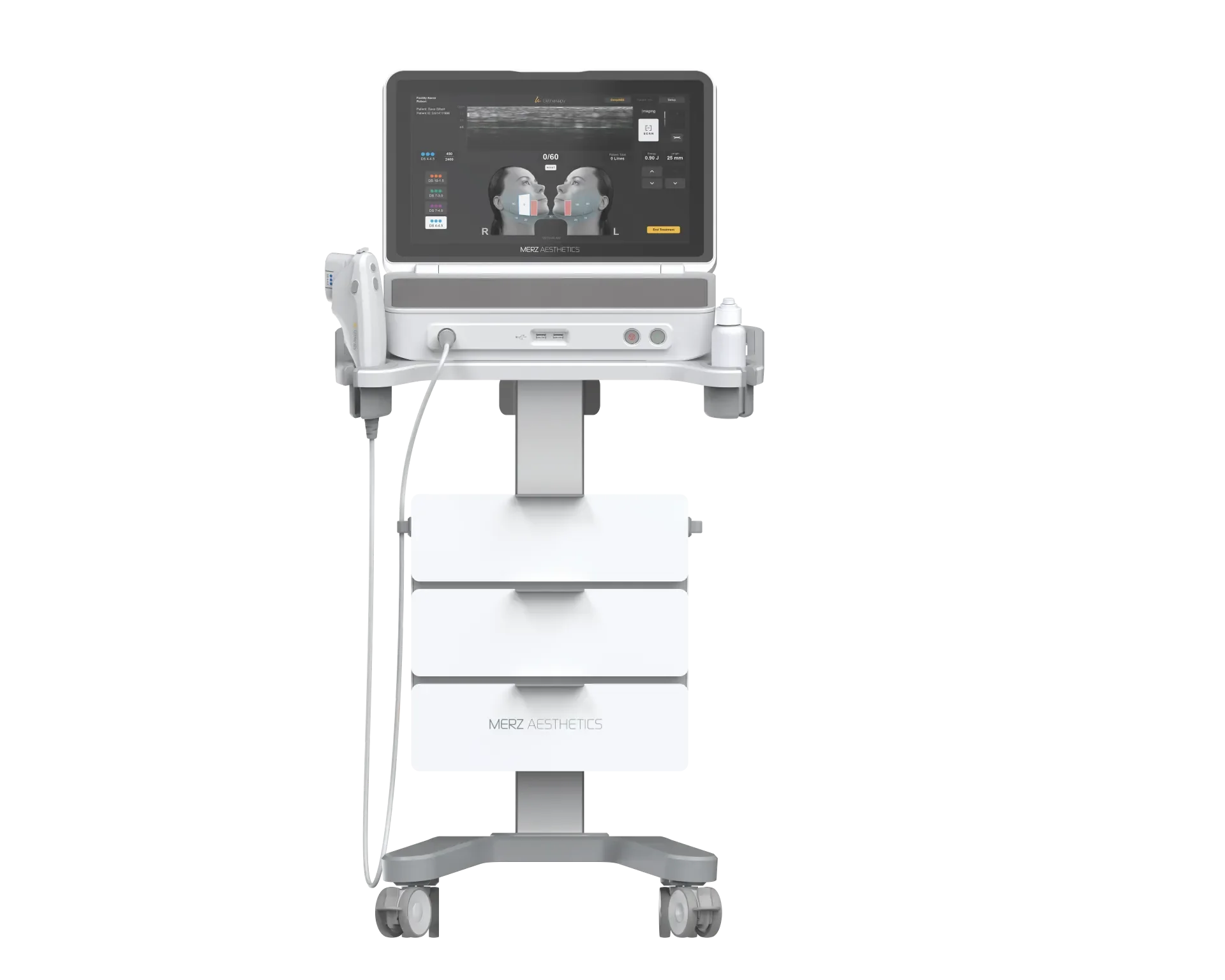
Merz Master Provider is a tiered device-specific training credential issued by Merz Aesthetics (the manufacturer of Ultherapy) to physicians who have completed advanced training on the Ultherapy device platform and met case-volume thresholds. The designation has three tiers in most markets — Provider (entry-level certification after initial device training), Advanced Provider (mid-tier, typically 100-plus documented Ultherapy cases), and Master Provider (top tier, typically 500-plus documented cases plus advanced protocol training and sometimes peer-instructor responsibilities). For Ultherapy patients, the Master Provider designation is the most meaningful tier because it signals high case volume (the strongest predictor of consistent clinical outcomes for energy-based device procedures) plus advanced protocol exposure (which matters for difficult anatomical zones like the periorbital region and submental neck). The honest caveat: the designation is issued by the device manufacturer, which means it reflects training compliance and case volume, not necessarily superior aesthetic judgment or patient outcomes (which are physician-specific). It is a strong baseline credential — clinics whose lead physician holds Master Provider are statistically more likely to have stable Ultherapy practice infrastructure — but it is not a guarantee of any specific aesthetic outcome. Cross-check Master Provider claims at the Merz Aesthetics professional directory or by asking the clinic to show the certificate.
KSD board certification and academic honors
The Korean Society of Dermatology (KSD, founded 1962) is the academic and specialty board for dermatology in Korea, equivalent in function to the American Academy of Dermatology or the British Association of Dermatologists. KSD board certification (specialty completion) is the baseline credential for any dermatologist practicing in Korea — it requires four years of post-medical-school residency plus board examination. For Ultherapy purposes, KSD board certification alone does not signal energy-based-device expertise (residency curricula are broad and not device-specific), but it is the floor credential. Above the baseline, KSD has several academic-honors layers worth knowing about. KSD Annual Meeting podium presenter status (peer-reviewed scientific session presentation at the yearly academic congress) signals research engagement and is more meaningful than passive attendance. KSD committee membership (energy-device committee, aesthetic dermatology committee) signals active society participation and is moderately meaningful. KSD-published peer-reviewed paper authorship in the Korean Journal of Dermatology or Annals of Dermatology, specifically on energy-based devices or HIFU/Ultherapy outcomes, is the strongest academic signal — these are publications that go through editorial peer review and reflect real clinical research engagement. Lower-tier KSD credentials (conference attendance certificate, society membership at the general level) are baseline credentials and do not differentiate meaningfully between Korean dermatologists. Cross-check: ask the clinic for the specific KSD honor, the year, and the citation if applicable; reputable clinics will have these documented in their physician CV section.
| KSD credential tier | What it signals | How meaningful for Ultherapy | How to verify |
|---|---|---|---|
| Board certification (specialty completion) | Baseline dermatology training | Floor credential — required not differentiating | KSD member directory |
| Annual Meeting podium presenter | Peer-reviewed research engagement | Strong signal of research depth | Annual meeting program archive |
| Energy-device committee membership | Active society participation in this domain | Moderate signal of subspecialty engagement | KSD committee roster |
| Peer-reviewed paper authorship on HIFU/Ultherapy | Publication-grade clinical research | Strongest academic credential | Korean Journal of Dermatology citation |
| Conference attendance certificate | Passive attendance | Baseline, not differentiating | Not publicly meaningful |
KHIDI foreign-patient-attraction registration
KHIDI (Korea Health Industry Development Institute) is the Korean government agency that operates the foreign-patient-attraction registry under the Medical Korea Act framework. KHIDI registration is required for any Korean medical facility or facilitator that wishes to legally market to foreign patients — it is the regulatory floor for international medical practice in Korea, not a clinical credential. For Ultherapy purposes, KHIDI registration of the clinic signals two things worth knowing. One: the clinic has agreed to operate under Medical Korea Act compliance standards, which include foreign-patient consent protocols, multilingual coordinator availability standards, and post-procedure complication tracking obligations. Two: the clinic has demonstrated administrative infrastructure for international patients (registration is not automatic; it requires application, document review, and ongoing compliance). KHIDI registration of the physician personally is less common — most registrations are at the facility level. The honest framing: KHIDI registration is necessary but not sufficient. It is the floor that separates legitimate foreign-patient-serving clinics from clinics operating outside the regulatory framework, but it does not differentiate between high-quality and average-quality Korean clinics, because most Seoul and Busan dermatology clinics serving international patients hold registration. Cross-check at the KHIDI English registry (publicly searchable). Registration number format is `A-YYYY-MM-DD-NNNNN` and can be looked up by clinic name.
MFDS device-handler clearance for Ultherapy PRIME
The Ministry of Food and Drug Safety (MFDS) is the Korean regulatory agency that clears medical devices for sale and use in Korea, including the Ultherapy PRIME device generation. MFDS clears the device itself (the hardware unit and transducer probes), not individual physicians, but for Ultherapy purposes there are two MFDS-related signals worth verifying. One: confirmation that the specific device unit at the clinic is the PRIME generation (the upgraded Merz device, released around 2023), not the legacy Ulthera unit. The MFDS clearance is issued at the device-model level; the clinic should be able to show the PRIME serial number on request, and the Merz Aesthetics website maintains a list of authorized PRIME providers in Korea. Two: confirmation that the device is on a current Merz service contract (annual transducer recalibration plus software update), because device maintenance status materially affects shot accuracy and energy delivery consistency. Older Ulthera units that have not been upgraded to PRIME remain in clinical use in some Korean clinics, particularly in secondary cities — they are clinically functional and MFDS-cleared, but they are a different device generation than what is typically marketed as Ultherapy in 2026 Korea. The honest cross-check: ask the clinic for the device model name (PRIME vs Ulthera), the year of purchase, and the most recent Merz service date. Clinics with the upgraded PRIME unit and current service tend to charge a 15-25 percent premium, which is the device-generation premium and worth understanding in context.
Korean Dermatological Association conference presence
The Korean Dermatological Association (KDA, distinct from but overlapping with KSD) hosts annual meetings, regional workshops, and energy-device-focused symposia where physicians present clinical experience and research. For Ultherapy purposes, KDA podium presence specifically on HIFU-or-Ultherapy topics is a strong signal — these are typically invited or peer-reviewed presentations that require demonstrated clinical case volume and outcome documentation. KDA energy-device symposium faculty status (named instructor at a regional or annual symposium teaching Ultherapy protocols to other physicians) is the strongest peer-recognition credential available in the Korean derm community for this specific procedure. The honest caveat: KDA presence does not directly translate to better patient outcomes for any individual patient, but it does signal that the physician is recognized by peer dermatologists as having teachable expertise on Ultherapy specifically — which is meaningfully different from a vendor-issued certificate or a Master Provider designation. Cross-check: ask the clinic for KDA annual meeting year, session title, and topic; reputable clinics will have this documented in physician CVs and sometimes link to the meeting program archive.
Credentials that are mostly marketing, not authority
Worth being honest about the credentials that show up on Korean clinic websites and matter less than the marketing implies. "Best Clinic Award" badges issued by media outlets or industry magazines are commercial placements in most cases — they are paid for by the clinic and do not reflect peer or patient evaluation. "International Aesthetic Society membership" credentials at the general-membership level are paid memberships that any practicing physician can hold; they signal nothing about Ultherapy-specific expertise. "Lecturer at industry conference" claims need cross-checking because industry-sponsored conferences (vendor-organized, not peer-reviewed) are different from peer-reviewed academic symposia like KDA or KSD events. "Featured in beauty publication" placements are typically promotional content. "Celebrity patient endorsements" are not credentials at all and tell you nothing about clinical Ultherapy experience for ordinary patients. None of these are necessarily disqualifying — clinics market themselves, and some commercial recognition is normal — but they should not substitute for the five categorical credentials above when you are evaluating clinical authority. The honest filter is to ask whether the credential is issued by an academic body (KSD, KDA), a regulatory body (MFDS, KHIDI), or the device manufacturer (Merz Aesthetics) with documented criteria — versus issued by a media outlet, industry magazine, or paid placement system. The first set is meaningful; the second set is marketing.
How to verify credentials yourself before you fly
The verification workflow that takes about 30 minutes per clinic, done at home before you book. Step one — ask the clinic for their lead Ultherapy physician's CV in English, specifically listing KSD board certification year, Merz Provider tier, KHIDI registration number for the facility, and any peer-reviewed publications or KDA presentations on energy-based devices. Step two — cross-check KSD board certification at the KSD member directory (Korean-language but searchable by physician name in Roman letters via the English-side query form). Step three — cross-check Merz Master Provider status at the Merz Aesthetics professional directory or by requesting a photograph of the certificate. Step four — cross-check KHIDI registration at the KHIDI English-side registry by entering the registration number in the format `A-YYYY-MM-DD-NNNNN`. Step five — for KDA presentations, ask for year and session title, then search the KDA annual meeting program archive (publicly available). Step six — confirm the Ultherapy device generation (PRIME vs legacy Ulthera) and most recent Merz service date. A clinic that responds to all six requests with documented answers within 24-48 hours is operating at the regulatory and credentialing floor that international medical patients should expect. A clinic that responds with marketing language and refuses to document specifics is a red flag, regardless of how their website looks.
“Credentials are a floor, not a ceiling. The five categorical credentials in this framework — Merz Master Provider, KSD board certification, KHIDI registration, MFDS device clearance, KDA peer recognition — give you the regulatory and academic baseline you should expect from any Korean Ultherapy clinic serving international patients. They do not guarantee any specific aesthetic outcome, but they materially reduce the variance.”
Sarah Mitchell, Korea Ultherapy credential-evaluation field notes 2026
Frequently asked questions
What is the most meaningful single credential to look for in a Korean Ultherapy physician?
Combined Merz Master Provider designation plus KSD board certification plus at least one peer-reviewed publication or KDA podium presentation on energy-based devices. Any one alone is partial signal; together they triangulate documented device-specific case volume, baseline dermatology training, and academic peer recognition.
Does KHIDI registration mean the clinic is government-endorsed?
No. KHIDI registration is a regulatory floor that requires clinics serving international patients to meet baseline compliance standards (consent protocols, coordinator availability, complication tracking). It is required for legal foreign-patient marketing in Korea but does not constitute clinical endorsement or quality ranking.
Are Merz Provider, Advanced Provider, and Master Provider tiers visible on clinic websites?
Sometimes yes, sometimes no. Reputable Korean clinics typically list the Merz tier in the physician CV section. If the website does not specify, ask directly — Merz issues physical certificates for each tier. The tier matters because case-volume thresholds for Master Provider are substantially higher than for entry-level Provider.
What if the physician is not KSD board-certified?
Some physicians performing Ultherapy in Korea have specialty backgrounds other than dermatology (plastic surgery, family medicine with aesthetic training). Korean law allows licensed physicians to operate aesthetic devices, but dermatology specialty residency is the most rigorous pathway. Plastic surgery is also a reasonable pathway. Other specialties without aesthetic dermatology training are weaker signals.
Do KSD or KDA publish ranked lists of Korean Ultherapy physicians?
No. Neither academic society publishes ranked lists for any procedure. Both publish member directories, committee rosters, and annual meeting program archives. Any third-party site claiming a ranked list of Korean Ultherapy physicians is a commercial placement service, not an academic authority.
How does Korean credentialing compare to US board certification?
Conceptually similar. KSD board certification (Korea) parallels American Board of Dermatology certification (US) — both require multi-year residency plus board exam. Merz Master Provider is the same device-specific credential globally. The structural difference is that Seoul has higher dermatology clinic density per capita than most US metros, so Korean physicians at major clinics typically accumulate Master Provider case-volume thresholds faster.
What about clinics that advertise their physician as a Merz KOL?
KOL (Key Opinion Leader) is a vendor-relationship designation rather than an academic credential. It often correlates with high case volume and Master Provider tier (vendors recruit KOLs from their highest-volume providers), so it is a positive secondary signal — but treat it as supporting evidence alongside Master Provider tier and KSD/KDA academic presence.
If I can only verify two credentials before booking, which two?
Merz Master Provider tier (or Advanced Provider minimum) plus KHIDI facility registration. The first confirms device-specific case volume and training; the second confirms regulatory compliance for international patient service. If a clinic cannot document both, look elsewhere.